

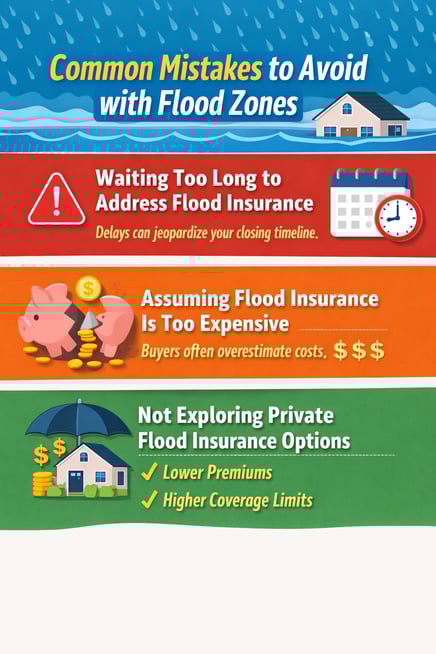

Finding out your Georgia property is in a flood zone can feel like a deal breaker, especially if you are days away from closing.
The good news is this situation is more common, and more manageable, than you might think.
In this guide, you will learn exactly what to do if your property is in a flood zone, what it means for your mortgage, how much it could cost, and how to move forward without delaying your closing.
Step 1: Confirm What Flood Zone You Are In
The first thing you need to do is identify your exact flood zone.
High-Risk Flood Zones in Georgia
If your property is in one of the following zones, it is considered a Special Flood Hazard Area:
- Zone A
- Zone AE
- Zone V
- Zone VE
Not all flood zones are treated the same.
Step 2: Understand What This Means for Your Mortgage
If your loan is federally backed and your property is in a high-risk flood zone, your lender will require flood insurance.
What Lenders Require
- You must have an active flood insurance policy before closing
- Coverage must meet minimum lender requirements
- You must maintain the policy for the life of the loan
Without flood insurance, your loan will not close.
Step 3: Get a Flood Insurance Quote Immediately
Timing matters, especially if you are close to your closing date.
The 30-Day Waiting Period Myth
Standard NFIP policies have a 30-day waiting period, but there is an important exception.
If you are purchasing a home, the waiting period is waived for loan closings.
This means you can:
- Get a quote quickly
- Bind coverage within 24 to 48 hours
- Stay on track for closing
Step 4: Understand What Flood Insurance Actually Costs in Georgia
One of the biggest fears buyers have is cost. The reality is often very different.
Real Flood Insurance Costs from Georgia Policies
Based on 71 recent policies:
- Zone AE, low end: around $100 per year in areas like North Georgia
- Atlanta Zone AE: $300 to $1,581 per year
- North Georgia mountains: $100 to $958 per year
- Savannah coastal areas: $1,041 to $9,981 per year
Median cost for Zone AE homes in Georgia is about $550 per year, which is less than $50 per month.
Step 5: Verify If the Flood Zone Is Correct
Sometimes, properties are incorrectly mapped into high-risk zones.
When a Flood Zone Might Be Wrong
- Your home sits on higher ground
- Elevation data is outdated
- Map changes were recently applied
What You Can Do About It
You may qualify for a Letter of Map Amendment, also known as a LOMA.
A LOMA can remove your property from the flood zone and eliminate the insurance requirement.
Step 6: Decide Your Next Move
At this point, you have three main options.
Option 1: Move Forward with Flood Insurance
This is the most common path.
- Keeps your closing on track
- Protects your property
- Often affordable
Option 2: Challenge the Flood Zone
If elevation supports it, pursue a LOMA.
- May remove insurance requirement
- Takes additional time
- Not always guaranteed
Option 3: Reevaluate the Purchase
In rare cases, especially in high-cost coastal zones, you may decide:
- The risk is too high
- The cost does not fit your budget
Frequently Asked Questions
Will being in a flood zone stop my closing?
No, but you must have flood insurance in place before closing if required by your lender.
How fast can I get flood insurance in Georgia?
In most cases, policies can be quoted and bound within 24 to 48 hours for closing.
Is flood insurance always expensive?
No. Many policies in Georgia cost less than $50 per month depending on location and elevation.
Can I remove my property from a flood zone?
Possibly. A LOMA may remove the requirement if your property is above base flood elevation.
What You Should Do Right Now
Finding out your property is in a flood zone can feel overwhelming, especially when you are up against a closing deadline.
The most important step is to act quickly and get accurate information.
If you are facing an upcoming closing or just found out your property is in a flood zone, your next step is to get a personalized flood insurance quote so you can move forward with confidence.
