


In a room outside the Maryland State Senate chamber last winter, consumer advocates were meeting privately with lawmakers to explain how borrowers were losing their homes over “zombie” loans, old second mortgages that they hadn’t heard from lenders about in years. At the time, the legislature was considering a bill to protect homeowners from unfair attempts to collect these debts.
Then Robert Enten barged in. The lobbyist for the Maryland Bankers Association began shouting about his opposition to the bill, according to three people with knowledge of the event who asked not to be identified discussing a private conversation. Others began shouting back, and the meeting soon broke up. In the weeks after, the bill passed the House of Delegates unanimously but stalled in the Senate and died.
“Unfortunately, we ran up against a calendar issue,” said Delegate Dana Jones, who co-sponsored the legislation in the House and reintroduced the measure this year. Enten declined to comment.
The episode highlighted how vehemently opposed parts of the financial industry have become to new consumer protections for zombie mortgages. Despite evidence submitted in lawsuits showing some debt collectors have demanded back interest for periods exceeding the statutes of limitations, the industry argues that abuses are rare while any disruption to the buying and selling of mortgages on the secondary market would harm home lending more broadly.
A Bloomberg News investigation last year found that more than 600,000 second mortgages taken out before the 2008 financial crisis — and then largely forgotten amid a wave of loan modifications during the recovery — remain outstanding across the country. Debt collectors buy these mortgages for pennies on the dollar and then demand homeowners pay bills that often include years of back interest.
Nearly all states have statutes of limitations that prohibit residential foreclosures if too much time has passed. These protections vary from just a few years after a debt becomes due to a decade or more. Even so, consumers who spoke with Bloomberg said they were unaware of the limits when approached by debt collectors.
Attention on zombie mortgages has been growing as public-interest attorneys file lawsuits and gather evidence that their clients are the victims of unlawful attempts to collect. Many of these advocates say the urgency for states to beef up consumer protections has increased since the Trump administration gutted the Consumer Financial Protection Bureau last year.
The agency had been raising the alarm about zombie second mortgages since 2023 and was investigating at least three firms involved in collecting them, Bloomberg reported last year. A spokesperson for the CFPB said the enforcement effort has not been abandoned, but declined to elaborate.
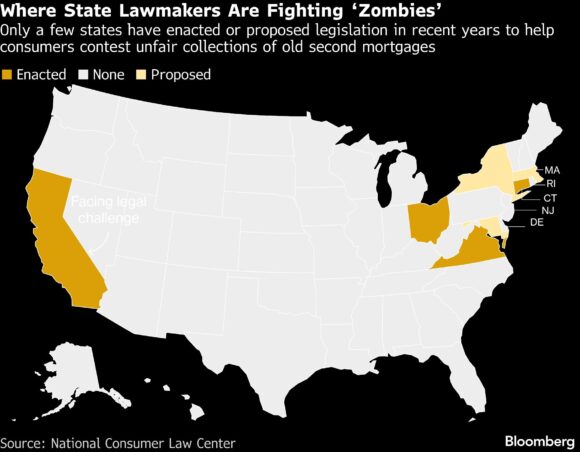
In states like Maryland, where Democrats control the legislature and governor’s office, measures that would make it easier for consumers to contest unfair bills have faced resistance. Only four states have managed to pass legislation addressing zombie loans, and at least one of them is facing a legal challenge.
A trade group representing the debt-collection industry said this state-by-state approach to regulation, rather than national rules, is inefficient and leads to greater costs for consumers.
“Having one federal standard is easier to administer than several state laws with different requirements,” said Scott Purcell, chief executive officer of the ACA International, an association for the credit and collections industry. He added that his organization’s members typically maintain robust compliance programs for both state and federal laws.
For borrowers, the absence of federal enforcement of consumer protection laws exposes them to debt collectors who have been accused of exploiting holes in the patchwork of state laws or ignoring them altogether, according to a review of more than 140 lawsuits. That’s why consumer advocates have argued for new protections in legislatures across the US.
“It’s like reinventing the wheel in each state,” said Andrea Bopp Stark, a senior attorney at the National Consumer Law Center, which has proposed model legislation to address zombie loans.
In California, consumer advocates learned that even after a law is adopted, the challenges aren’t over.
In June, Governor Gavin Newsom signed a law that requires debt collectors to attest to proper, continuous management of the loan, or acknowledge lapses, if they want to foreclose through the state’s swifter, non-judicial process.
Less than three months later, trade groups representing private lenders and credit unions, along with debt collection firms and several anonymous creditors filed a federal lawsuit contesting the new rules. They said the measure violated their constitutional rights and would make it harder for Californians to get credit.
The law “arbitrarily applies to a vastly broader class of mortgage loans than this kind of outlier ‘zombie loan’ that the new statute was intended to remedy,” they said in a filing.
At least one of the companies that joined the suit has been directly involved in collecting zombie loans in recent years. The plaintiff, ZBS Law, managed the foreclosure of a home outside San Francisco for a debt buyer that Bloomberg profiled in October.
The law firm said in a legal filing that the new statute would open it, and other foreclosure firms, to liability if they didn’t adhere to its “vague” requirements. Robert McWhorter, an attorney at Buchalter representing ZBS and the other plaintiffs in the suit, declined to comment.
California’s Department of Justice, which is defending the law, has emphasized in legal filings that the plaintiffs had failed to prove that it had caused a widespread upheaval in the mortgage market. In a legal brief this year, they cited Bloomberg’s reporting on the scope of the zombie mortgage crisis and harm to consumers.
A spokesperson for Attorney General Rob Bonta’s office declined to comment. The federal judge hearing the case has yet to rule on the state’s effort to dismiss the lawsuit, and the business group’s push to strike down the requirements.
Officials from states that have put consumer protections in place said the concerns the financial industry has raised — that costs will go up and people will have trouble getting loans — have so far not materialized.
Virginia lawmakers passed a new provision in 2024 that required debt collectors to sign legal documents attesting that the amount of back interest owed was accurate before foreclosing on old second mortgages. Kristi Kelly, a public-interest attorney who encouraged adoption of the law, said zombie foreclosures seemingly stopped in the state for a year afterward.
When the measure was under consideration, though, some debt collectors said it would make it “too risky” for them to pursue even legitimate debts, said Delegate Marcus Simon, who sponsored the measure.
“Everybody adapted to follow the law,” said Simon, a Democrat whose district covers part of the DC suburbs. “It took them a little bit longer to foreclose, and it’s a smaller number of foreclosures. But, on balance, that’s a relatively small price to avoid predatory actors taking people’s homes.”
In Maryland, Delegate Jones, who represents Annapolis and surrounding areas, initially worked with the state’s Office of Financial Regulation to craft a measure that would protect consumers from zombie loans, relying on a complex procedure for contesting foreclosures. It was while legislators were weighing this draft that the consumer advocates met privately with senators, according to people familiar with the event.
The discussion was a chance for advocates to make the case for why the additional protections were needed. It began cordially enough. Proponents of the bill spoke of Marylanders who’d faced shockingly large bills on mortgages that they hadn’t heard about in more than a decade, and how difficult it was to contest debt collectors’ assertions of what was owed.
But when Enten interrupted, the back-room discussion devolved, the people said, with the veteran lobbyist cutting others off and pounding his fists. After a few minutes, Senator William Smith, who chairs the committee that was debating the bill, broke the meeting up, saying he’d heard enough, according to two of the people. Smith did not respond to questions sent to his chief of staff. The proposal never made it out of Smith’s committee.
By March 2025, Delegate Jones and her colleagues had revised and simplified the bill, which would bar residential foreclosures 10 years after default. Maryland and Alabama are the only states with no statute of limitation for residential foreclosures. The bill also required debt collectors to provide more proof that they were charging an accurate amount of interest on second mortgages that had been delinquent for five years or more.
The revised version passed the House 139-0 last March.
Even in Maryland’s compressed legislative session, the Senate had time to act last year. But, ultimately, the clock ran out.
In an interview in January, Jones said she was undeterred. “The idea that this would be allowed, that homeowners who thought they were safe are being targeted at a time when people are trying to afford groceries, is unbelievable,” she said.
She’s more optimistic about the bill’s passage this year. The House approved it last Thursday, but it hasn’t passed out of committee in the Senate.
And there are still opponents.
Last month, during a hearing on the bill, Enten cautioned delegates against making changes that would limit banks’ abilities to sell loans. “This is a miniscule issue, but a law that we are very much afraid will have a serious impact on the secondary market.”
Bloomberg’s analysis last year found nearly 25,000 old second mortgages are still outstanding in Maryland.
Top photo: Kristi Kelly, a public-interest lawyer, in her office in Fairfax, Virginia. Photographer: Alyssa Schukar/Bloomberg.
Copyright 2026 Bloomberg.
Topics
California
Maryland