

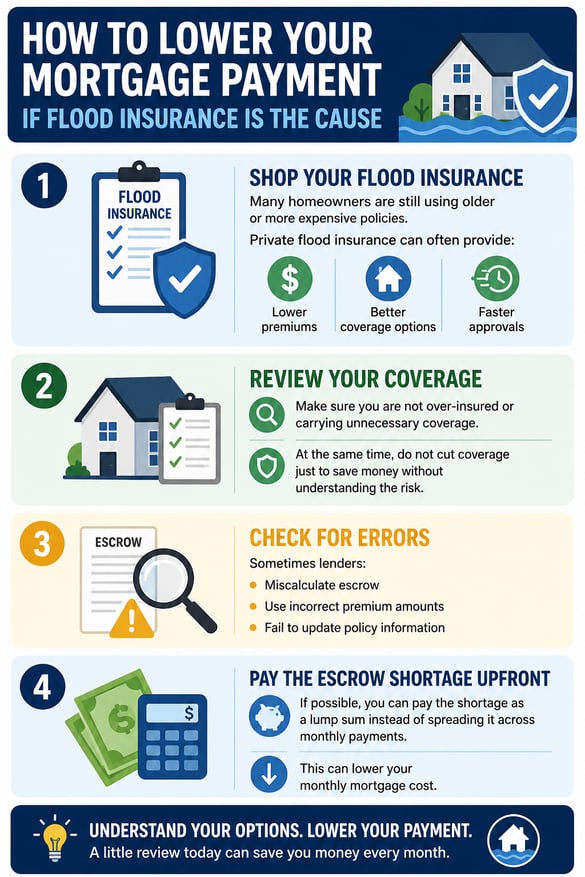

You are not alone if your mortgage payment went up and you were not expecting it.
This is one of the most common calls we get at Flood Insurance Guru.
A homeowner gets a notice from their lender, sees their monthly payment jump, and immediately assumes something went wrong. In many cases, the cause is tied directly to flood insurance and how it is handled through escrow.
The confusion usually comes down to one simple issue. Most people do not fully understand how escrow works.
What Is an Escrow Account and How Does It Work?
An escrow account is set up by your mortgage company to pay property-related expenses on your behalf.
This typically includes:
- Property taxes
- Homeowners insurance
- Flood insurance, if required
This means your monthly payment is not just your loan. It is a combination of principal, interest, taxes, and insurance.
Why Flood Insurance Causes Mortgage Payments to Increase
1. Your Lender Required Flood Insurance
If your property was newly identified in a high-risk flood zone, your lender may now require flood insurance.
This often happens due to:
- Updated flood maps
- Loan reviews or audits
- Property purchases or refinancing
When flood insurance is added for the first time, your escrow account must now cover that cost. That means your monthly payment increases.
2. Your Flood Insurance Premium Increased
This can be due to:
- FEMA Risk Rating 2.0 updates
- Changes in property risk
- Carrier pricing adjustments
- Coverage changes
If your premium increases, your escrow account needs more money to cover the higher bill. Your lender adjusts your monthly payment to make up the difference.
3. Escrow Shortage from Last Year
If your escrow account did not collect enough to cover your flood insurance premium last year, you now have a shortage.
Your lender will:
- Increase your monthly payment going forward
- Add extra to repay the shortage
4. Force Placed Flood Insurance
If your lender believes you do not have adequate flood insurance, they can place a policy on your property.
This is called force placed insurance.
It is usually:
- Much more expensive
- Designed to protect the lender, not you
- Limited in coverage
How Much Can Flood Insurance Increase Your Payment?
It depends on the premium and how your escrow is structured.
For example:
- A $1,200 annual flood policy adds about $100 per month
- A $3,000 premium adds about $250 per month
- If there is an escrow shortage, that amount can double temporarily
Frequently Asked Questions
Why did my mortgage payment go up even though my loan did not change?
Your payment includes escrow for taxes and insurance. If flood insurance was added or increased, your total payment will go up.
Can my lender require flood insurance?
Yes. If your property is in a high-risk flood zone, lenders are required to ensure flood insurance is in place.
What is an escrow shortage?
An escrow shortage happens when your account does not have enough funds to cover your insurance or taxes. Your lender increases your payment to recover the difference.
Can I remove flood insurance to lower my payment?
Only if your lender no longer requires it. If it is mandatory, removing it can lead to force placed insurance, which is usually more expensive.
Understanding the Real Reason Behind Your Higher Payment
If your mortgage payment increased, there is always a reason, and flood insurance is one of the most common ones we see.
Most homeowners feel frustrated because the change is unexpected.
If your payment went up and you are not sure why, your next step is simple.
When it comes to flood insurance, the difference between the right policy and the wrong one can cost you every single month. Click below and start by getting a free policy review.
