


If your property is located in Flood Zone AE, you may be searching for services that can help reclassify your home into Flood Zone X to potentially remove mandatory flood insurance requirements.
The challenge is that flood zone reclassification is not a simple paperwork process. Depending on the property, homeowners may need elevation certificates, surveys, FEMA documentation, floodplain reviews, property records, and insurance-related flood map information.
Homeowners looking to reclassify a property from Flood Zone AE to Zone X may need help from certified surveyors, engineers, flood insurance agents, government property records, and sometimes local floodplain managers depending on the property and FEMA requirements.
At Flood Insurance Guru, we’ve completed more than 1,000 flood zone reclassification requests nationwide with an 86% success rate. We’ve also seen firsthand how missing documentation, incorrect submissions, and confusing pricing structures can delay or complicate the FEMA review process.
In this article, you’ll learn:
- which services commonly help with flood zone reclassification
- what each type of provider actually does
- how much these services may cost
- what may prevent approval
- and what homeowners should know before hiring help
Key Takeaways
- Reclassifying a property from Flood Zone AE to Zone X usually starts with reviewing an elevation certificate.
- Homeowners may need help from surveyors, engineers, insurance agents, floodplain managers, and FEMA resources.
- If the lowest adjacent grade is below Base Flood Elevation, the property may not qualify.
- Elevation certificates can cost anywhere from $500 to more than $2,000 depending on the location.
- Floodplain manager reviews involving filled dirt may cost approximately $500.
- Government records and FEMA resources are often available at little to no cost.
- Some companies charge flat fees, while others base pricing on flood insurance premiums.
- Flood Insurance Guru charges a flat fee of $1,000 with a 100% money-back guarantee if the reclassification is unsuccessful.
- FEMA typically takes about 30 days for an initial review.
- Moving into Flood Zone X does not eliminate flood risk.
Table of Contents
Watch: How Flood Zone Reclassification Works
What Does Flood Zone AE Mean?
Flood Zone AE is considered a Special Flood Hazard Area by FEMA. If you have a federally backed mortgage and your property is located in Flood Zone AE, your lender will usually require flood insurance.
Prefer video? Watch below for a breakdown of how Flood Zone AE works and how it may impact flood insurance requirements.
You can also review official flood map information through the FEMA Flood Map Service Center.
What Is Flood Zone X?
Flood Zone X generally represents areas with lower flood risk compared to Flood Zone AE.
However, Zone X does not mean there is no flood risk. Properties in Zone X can still flood because of heavy rainfall, drainage issues, hurricanes, flash flooding, or storms that exceed historical flood models.
Prefer video? Watch below for a breakdown of what Flood Zone X means and how it may impact flood insurance requirements.
A lower-risk flood zone does not eliminate the possibility of flooding.
What Services Are Typically Needed for a Flood Zone Reclassification?
Reclassifying a property from Flood Zone AE to Zone X often requires more than submitting a form to FEMA.
Depending on the property, homeowners may need help from:
- a certified surveyor or engineer
- government property records
- a flood insurance agent
- and sometimes a local floodplain manager
Each resource plays a different role in the flood zone reclassification process.
Flood Zone Reclassification Services, Costs, and Common Issues
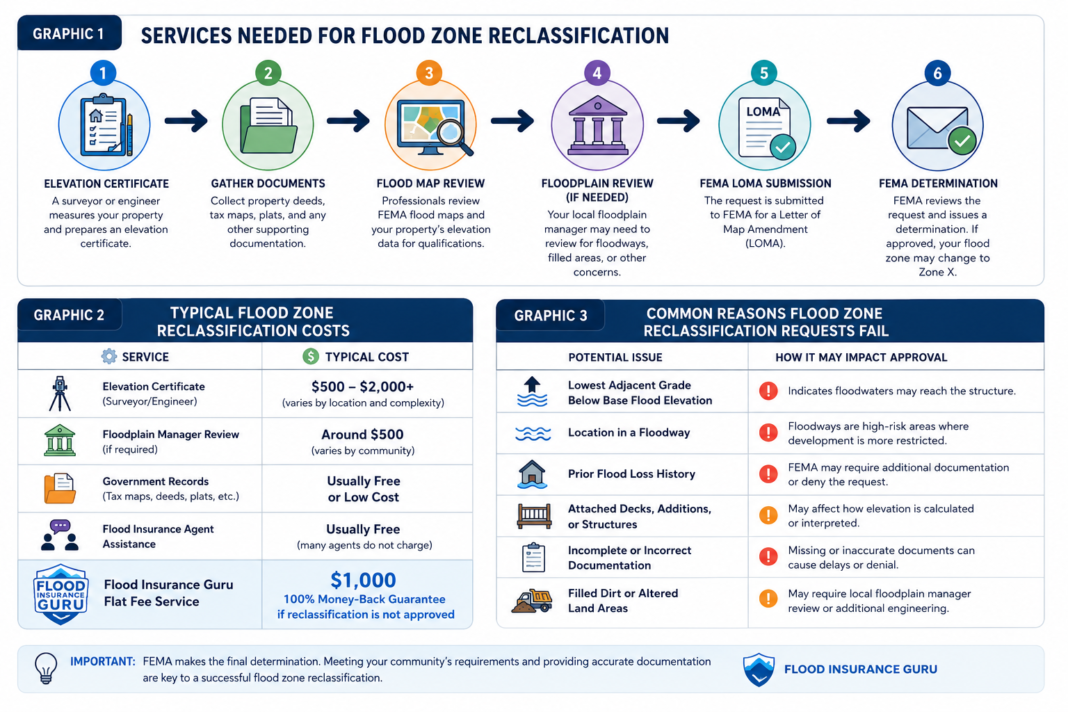
The graphic below shows the typical services involved in a flood zone reclassification, common cost ranges, and issues that may prevent approval.
Typical services, costs, and approval challenges involved in FEMA flood zone reclassification requests.
Certified Surveyors and Engineers
One of the most important parts of a flood zone reclassification request is the elevation certificate.
A certified surveyor or engineer is typically responsible for preparing this document.
The elevation certificate helps determine:
- the structure’s elevation
- the lowest adjacent grade
- Base Flood Elevation comparisons
- whether the property may qualify for a flood zone change
In many situations, if the lowest adjacent grade on the elevation certificate is below the Base Flood Elevation, the property may not qualify for reclassification.
Prefer video? Watch below for a breakdown of how elevation certificates work and why they are one of the first steps in determining whether a property may qualify for flood zone reclassification.
You can also learn more from FEMA’s elevation certificate guidance.
The elevation certificate is often the first step in determining whether a flood zone change is even possible.
Government Property Records and FEMA Resources
Flood zone reclassification requests often require supporting documentation from government agencies and FEMA resources.
These documents may include:
- tax assessor maps
- property deeds
- subdivision plats
- legal property descriptions
- FEMA flood maps
This documentation helps FEMA verify property boundaries, structure locations, flood zone placement, and map accuracy.
Missing or inconsistent records can significantly delay the FEMA review process.
Flood Insurance Agents
Flood insurance agents can play an important role during the reclassification process by helping homeowners obtain Flood Insurance Rate Maps, also called FIRMs.
These maps help show FEMA:
- where the property is located
- how the structure sits within the Special Flood Hazard Area
- what flood zone currently applies to the property
Flood insurance agents may also help homeowners understand current flood insurance requirements, lender requirements, and how a flood zone change could impact coverage options.
Floodplain Managers
In some situations, homeowners may also need assistance from a local floodplain manager.
This is especially common when:
- a property is located within a regulatory floodway
- filled dirt is being used for reclassification
- local floodplain approvals are required
Floodplain managers may need to review and sign off on certain documentation before FEMA completes the review process.
On average, floodplain manager assessments involving filled dirt may cost approximately $500, although costs can vary by community.
Floodway properties often face additional scrutiny during the flood zone reclassification process.
What Do Flood Zone Reclassification Services Cost?
The cost of flood zone reclassification can vary depending on the property, location, and services needed during the process.
Elevation Certificate Costs
In some areas, elevation certificates may cost as little as $500. However, in higher-cost markets, costs can exceed $2,000 depending on the complexity of the property and local pricing.
For example, elevation certificate costs in New York may be significantly higher than costs in smaller markets like Florence, Alabama.
The cost often depends on:
- property complexity
- local labor costs
- survey requirements
- property accessibility
- regional demand
The elevation certificate is often one of the largest upfront costs in the flood zone reclassification process.
Flood Insurance Agent Costs
In most cases, homeowners should not expect to pay a separate fee to a flood insurance agent for helping obtain Flood Insurance Rate Maps or reviewing flood insurance information during the process.
Government Records and FEMA Resources
Many government maps and FEMA resources needed during the process can typically be accessed at little to no cost.
Some counties or municipalities may charge small fees for certified copies or property documentation.
Floodplain Manager Fees
If a property is located within a floodway or involves filled dirt, homeowners may need assistance from a local floodplain manager.
In many situations, floodplain manager reviews involving filled dirt may cost approximately $500, although costs can vary depending on the community and complexity of the review.
Costs for Flood Zone Reclassification Services
In addition to costs for elevation certificates or floodplain reviews, homeowners may also pay for professional assistance with the flood zone reclassification process itself.
Pricing models can vary depending on the company.
Some companies use flat-fee pricing for flood zone reclassification services, while others base their pricing on the homeowner’s flood insurance premium.
At Flood Insurance Guru, we use a flat-fee pricing model of $1,000 for flood zone reclassification services, along with a 100% money-back guarantee if the flood zone is not successfully reclassified.
We chose a flat-fee structure because we believe it creates more predictable pricing for homeowners regardless of their flood insurance premium.
That said, premium-based pricing is not always more expensive. For example, homeowners with flood insurance premiums around $500 may sometimes pay less under a premium-based pricing model, while homeowners with premiums closer to $10,000 could pay significantly more.
Different flood zone reclassification companies may structure pricing differently, so homeowners should understand how fees are calculated before choosing a service.
Can You Submit a FEMA LOMA Request Yourself?
Yes. Homeowners can submit flood zone reclassification requests directly to FEMA through the official FEMA Letter of Map Amendment process.
However, many homeowners spend months going back and forth with FEMA because supporting documents are incomplete, inconsistent, or missing entirely.
In our experience, the process is often less about filling out forms and more about understanding which documents FEMA needs to support the request.
FEMA typically takes about 30 days for an initial review. If additional documentation is requested, each review cycle may add more time to the process.
What Can Prevent a Flood Zone Change From AE to X?
Not every property qualifies for reclassification.
Some common issues that may impact approval include:
- floodway location
- lowest adjacent grade below Base Flood Elevation
- prior flood loss history
- attached structures like decks or additions
- incomplete documentation
- filled dirt or altered land areas
- local floodplain management concerns
For example, we’ve seen situations where attached decks affected how a property was evaluated during the review process.
Properties located within regulatory floodways may also face additional scrutiny from FEMA or local floodplain managers.
Not sure whether your property may qualify? Start by reviewing your current flood zone and elevation data through our Flood Zone Lookup Tool.
Does Moving to Zone X Lower Flood Insurance Costs?
Sometimes — but not always.
Flood insurance pricing can consider several factors beyond flood zone classification alone, including distance to water, elevation characteristics, rebuilding costs, flood frequency, and property-specific flood risk.
You can learn more about this relationship in our article on Flood Zone AE vs Zone X cost differences.
In some situations, moving into Flood Zone X may reduce premiums or eliminate lender requirements. In other cases, the premium impact may be minimal.
Flood zone changes and flood insurance pricing are related — but they are not the same thing.
A Flood Zone Change Does Not Eliminate Flood Risk
Even if a property is successfully reclassified into Flood Zone X, that does not mean the flood risk disappears.
Flood zone changes primarily affect FEMA map classifications and potentially lender requirements.
Properties in Zone X can still flood during severe storms, flash flooding, drainage failures, hurricanes, and extreme rainfall events.
In many situations, maintaining flood insurance after a successful reclassification may still be worth considering.
Frequently Asked Questions About Flood Zone Reclassification Services
What services are needed for a flood zone reclassification?
Homeowners may need help from certified surveyors, engineers, flood insurance agents, government property records, FEMA resources, and sometimes local floodplain managers.
Who prepares an elevation certificate?
A certified surveyor or engineer typically prepares the elevation certificate needed to evaluate whether a property may qualify for a flood zone change.
Can I submit a FEMA LOMA request myself?
Yes. Homeowners can submit a FEMA LOMA request themselves, but missing or incomplete documentation can delay the process.
What does a floodplain manager do?
A floodplain manager may review floodway issues, filled dirt concerns, or local floodplain requirements that could impact a FEMA reclassification request.
How much does an elevation certificate cost?
Elevation certificates may cost as little as $500 in some areas, but costs can exceed $2,000 in higher-cost markets or complex property situations.
What happens if my lowest adjacent grade is below Base Flood Elevation?
If the lowest adjacent grade is below Base Flood Elevation, the property may not qualify for a flood zone reclassification.
Does Flood Zone X mean no flood risk?
No. Flood Zone X generally means lower flood risk than Flood Zone AE, but properties in Zone X can still flood.
How long does FEMA take to review a flood zone change?
FEMA typically takes about 30 days for an initial review. Additional documentation requests can extend the timeline.
Do flood insurance agents charge for flood map reviews?
In most situations, flood insurance agents do not charge a separate fee to review flood maps or help obtain flood insurance-related map information.
How much does Flood Insurance Guru charge for flood zone reclassification?
Flood Insurance Guru charges a flat fee of $1,000 for flood zone reclassification services and offers a 100% money-back guarantee if the reclassification is unsuccessful.
Final Thoughts on Flood Zone Reclassification Services
Understanding which services are needed for flood zone reclassification can help homeowners avoid delays, incomplete submissions, and confusion during the FEMA review process.
While some homeowners choose to handle the process themselves, working with experienced professionals may help streamline documentation and identify potential issues earlier in the process.
At Flood Insurance Guru, we’ve helped complete more than 1,000 flood zone reclassification requests nationwide while helping homeowners better understand flood maps, elevation certificates, and FEMA requirements.
If you want to better understand whether your property may qualify for a flood zone change, start by reviewing your elevation certificate and current flood map information.
