

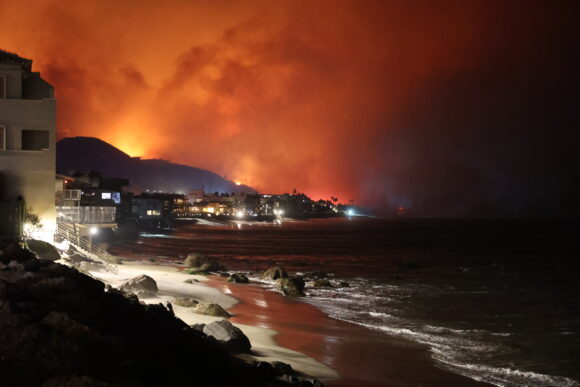

The Los Angeles wildfires that kicked off 2025 not only sped up a statewide homeowners insurance market pullback, but they also played a part in an ongoing reshaping of California’s surplus lines market, according to a new report.
The state’s surplus lines insurance market has entered a new phase that can be best defined as a “structural shift,” a market analysis from The Surplus Line Association of California shows.
The SLACAL report is part of the group’s annual report. It examines how legal risk, catastrophe exposure, capital constraints and regulatory friction reshaped where risk is placed and how coverage is accessed in the state’s surplus lines marketplace.
Related: Bill Introduced to ‘Transform’ the California FAIR Plan
The analysis, which includes policy data and insight from executives, shows a sustained reallocation of risk from the standard market into surplus lines.
In the last few years, the new policy counts in California surplus lines has swelled more than 500%. It is part of a change that has been ongoing for a dozen years, partly driven by the plague of wildfires in California in recent years. Fourteen of top 20 destructive wildfires in state history have occurred in the last 10 years, according to CalFire statistics.
Benjamin J. McKay, CEO and executive director of SLACAL, views the L.A. fires as the exclamation point in a years-long process unfolding in the state’s insurance market that has made it difficult for admitted carriers to provide homeowners insurance in the state.
Proposition 103, which mandates rate reviews and an intervenor process among other regulations, has been called out by the insurance industry for preventing carriers from accurately pricing for risk and getting appropriate rates in California.
“Prop 103 really made it challenging for admitted carriers to get rate, and for years and years and years, it didn’t matter because (admitted carriers) could make it up with investment income,” McKay said.
In addition to investment income, carriers were aided by profit from other lines, such as selling auto coverage to the same homeowners insurance customer.
“And then about 15 years ago that stopped being the reality, and now they had to make an underwriting profit, and once they had to make an underwriting profit, they couldn’t do it in California because they couldn’t get rate,” McKay said. “I think that was really the tipping point, and I think the L.A. fires are really just the exclamation point. That’s when everyone realized this is where we’re going into a surplus lines world for homeowners.”
The movement into surplus lines also included homeowners going into the California Fair Plan, the insurer of last resort with limited coverage. That migration prompted the state’s insurance regulator to push changes to the Fair Plan, including most recently a bill to initiate reforms to the FAIR Plan that proponents say will strengthen claims handling, expand coverage options, and improve transparency for wildfire survivors.
According to the SLACAL report, the standard market’s pullback is no longer isolated to high-risk or rural regions, but it increasingly affects urban and suburban areas. This is what has led to even more personal lines activity entering the surplus lines market.
Related: The Return Period for An LA Wildfire-Scale Event May Be Shorter Than You Think
“The year 2025 marked a decisive turning point for California’s property insurance landscape,” the report states. “What began as a gradual pullback by admitted carriers in recent years intensified into a sustained contraction in admitted availability as observed through spillover into surplus lines.”
That shift coincided with the worsening wildfire exposures as well as broader market pressures that continued to strain coverage accessibility across large portions of the state.
Insurers have paid more than $22.4 billion on tens of thousands of claims from the L.A. wildfires, according to the latest data from the California Department of Insurance. A one-year report on the L.A. wildfires from Morningstar DBS Research called the fires “a significant stress event” for California’s property/casualty insurance sector.
The L.A. wildfires lead to several changes to insurance regulations, including fast-tracking rate reviews to get insurers to return to writing homeowners insurance in risky areas, enabling the use of more sophisticated catastrophe modeling and allowing carriers to factor reinsurance rates into pricing.
The regulations encouraged carriers to look at writing in risky areas of the state in order to get rate hikes. Two large California home insurers will be raising rates for by an average of 6.9% this year. CSAA will begin rate increases for nearly 481,800 homeowners starting in March. Mercury Insurance is expected to begin the rate hikes in July for more than 650,000 homeowners.
As this has unfolded, the state’s surplus lines market grew rapidly. Following a modest increase to roughly 50,000 policies in 2023, new business surged to 320,000 policies in 2025, the report shows.
SLACAL research shows another major shift: the types of homes entering the surplus lines market have changed. Historically, surplus lines homeowners policies tended to be for homes with multimillion-dollar replacement costs and elevated wildfire exposure.
In 2025, the profile shifted toward more typical admitted-market homes, with the average assessed value falling to $800,000 (from $900,000 in 2024), while average premiums fell $14.5%, the report shows.
The influx of homeowners policies into surplus lines follows a growth in commercial lines that the group has been watching since around 2014. The state’s surplus lines sector has experienced an increase from writing 6% of the commercial market to writing 20% of the commercial insurance market, according to McKay.
“As the market grew from 6% to almost 20%, the thought was for several years that it would shift back,” he said. “And about five years ago, we started coming to the conclusion that it’s not shifting back; this is a permanent reality, that for whatever reason there have been structural changes that have changed the marketplace fundamentally,” he said.
Roughly five years ago, the same type of shift began with personal lines.
“When I got to the SLA 13 years ago, personal lines was 1.5% of the policies, and now it’s 10%—so that’s a huge increase,” McKay said.
Is the movement into the surplus market just a temporary safety valve in which homeowners are looking to find coverage or is this a lasting change?
Unless regulations are changed and market conditions shift, McKay believes that what we’re seeing in the surplus market will be lasting and that this is “the new reality now for personal lines.”
Top photo: 2025 Pacific Palisades Fire. Source: CalFire.
Topics
California
Excess Surplus