


Are you paying more than you should for flood insurance in Houston’s Flood Zone AE?
If you own a home in Zone AE, flood insurance is often required by your lender, and premiums can exceed $2,000 per year in higher risk areas. The good news is that you may have more control than you think.
In this guide, you will learn how to lower flood insurance in Flood Zone AE in Houston by comparing private and NFIP options, correcting rating errors, adjusting deductibles strategically, understanding elevation impact under Risk Rating 2.0, and planning for long term rate increases.
Why Flood Insurance in Houston Zone AE Is So Expensive in 2026
Flood Zone AE is considered a high risk zone with a 1 percent annual chance of flooding, often referred to as the 100 year floodplain. However, under Risk Rating 2.0, FEMA no longer relies primarily on flood zone maps.
Today, your premium is driven by property level modeling that includes:
- Distance to water sources
- Type of water source, bayou, creek, reservoir, or coastal surge
- Elevation relative to Base Flood Elevation
- Foundation type
- Replacement cost value
- Historical flood frequency models
1. Compare Private Flood Insurance vs NFIP in Houston Zone AE
This is the most overlooked strategy.
In our 2026 Houston Zone AE comparison dataset:
- Median NFIP quote: $2,338 per year
- Median private quote: $1,116 per year
- Private was less expensive in approximately 72 percent of cases
Private insurers use proprietary catastrophe models and may weigh risk differently than FEMA. Some carriers are more competitive for homes farther from primary water sources or with favorable elevation characteristics.
2. Verify Replacement Cost Accuracy, A Hidden Pricing Lever
Flood insurance premiums are partially tied to your home’s replacement cost, especially under Risk Rating 2.0.
We regularly uncover:
- Overestimated rebuild values
- Incorrect square footage
- Misclassified foundation types
- Rating inputs that do not match the property
Correcting rebuild cost inputs can reduce premiums without reducing coverage.
3. Increase Your Deductible Strategically, With Realistic Expectations
Raising your deductible can reduce your annual premium, but the impact under Risk Rating 2.0 is often incremental, not dramatic.
Before adjusting your deductible, consider:
- Lender requirements
- Your cash reserves
- Your tolerance for risk in a claim scenario
Deductible changes can help, but they are rarely the biggest lever in Zone AE.
4. Elevation Certificates Under Risk Rating 2.0, When They Matter
Before Risk Rating 2.0, elevation certificates were often the primary tool for lowering premiums in Zone AE.
Today, they still matter, but they are one variable among many.
An elevation certificate may help if:
- Your lowest floor is above Base Flood Elevation
- FEMA mapping does not fully reflect your property’s relative height
- Your home was previously rated conservatively
5. Plan for Long Term Rate Increases in Flood Zone AE
Under FEMA’s glide path rules, annual increases are typically capped, often around 18 percent, until a property reaches its full risk based rate.
That means your current premium may not reflect your eventual steady state price.
Lowering flood insurance is not just about this year’s premium, it is about your long term trajectory.
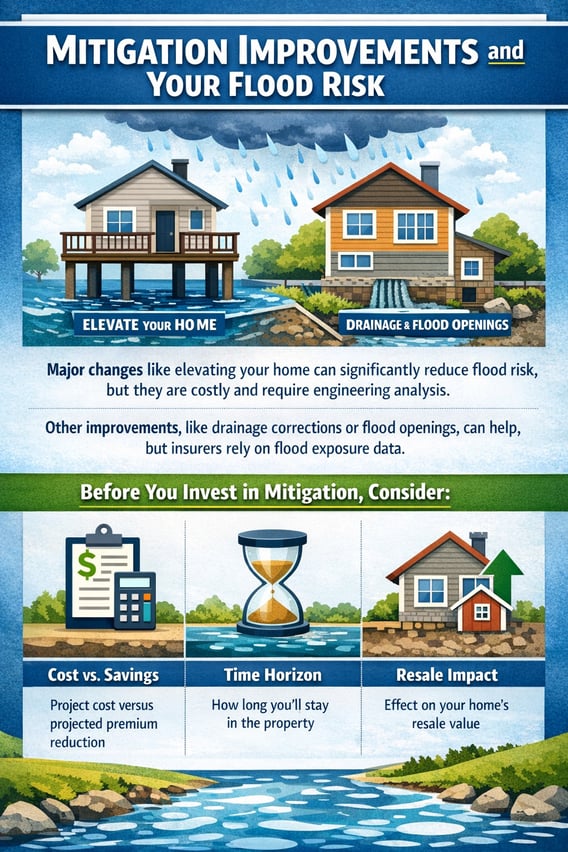
Mitigation Improvements, Long Term Structural Solutions
Frequently Asked Questions
Can you remove flood insurance if you are in Flood Zone AE?
If you have a federally backed mortgage and your property is in Zone AE, your lender will typically require flood insurance. You may only remove it if a Letter of Map Amendment or similar determination changes your flood zone designation.
Is private flood insurance allowed in Zone AE in Houston?
Yes. Most lenders accept private flood insurance as long as it meets regulatory requirements. Always confirm with your lender before switching.
Does Risk Rating 2.0 make flood insurance cheaper?
For some homeowners, yes. For others, no. Risk Rating 2.0 aligns pricing more closely with modeled property level risk, which means some premiums decreased while others are increasing toward full risk rates.
How much can you realistically lower flood insurance in Houston AE?
It depends on your current carrier, rating inputs, and property characteristics. In our 2026 Houston Zone AE dataset, the median difference between NFIP and private quotes exceeded $1,200 per year.
How to Lower Flood Insurance in Flood Zone AE in Houston
If you are in Houston’s Flood Zone AE, you already know flood insurance is not optional for most mortgages and not inexpensive. You may have felt frustrated watching premiums rise without understanding why.
Now you understand that your flood zone alone does not determine your cost. Private versus NFIP comparisons, replacement cost accuracy, deductible structure, elevation data, and long term rate trajectory all play a role.
We specialize in helping Houston homeowners analyze both NFIP and private flood options, identify rating errors, and understand where their premium is headed over time. If you want to see whether you are overpaying in Zone AE, your next step is to let us help you review your options with clarity and confidence.
