


If you recently got an elevation certificate, you are probably asking the same question we hear every week: “Does this mean I can cancel my flood insurance now?”
The short answer is, sometimes. But most of the time, the better question is not whether you can cancel, it is whether you should.
This is where a lot of homeowners make the wrong decision, because no one walks them through what the elevation certificate actually does and how it impacts their risk.
Let’s break it down clearly so you can make the right call for your situation.
What an Elevation Certificate Actually Does
An elevation certificate is a document prepared by a licensed surveyor that shows how your home sits relative to expected flood levels.
It includes key details like:
- The elevation of your lowest floor
- The base flood elevation for your area
- The type of foundation, such as slab or crawlspace
- Flood venting and building characteristics
Before this information is collected, your property may be rated using estimates or conservative assumptions. Once the elevation certificate is in place, your flood risk can be evaluated more accurately. That can lead to lower premiums, but it does not automatically remove risk.
When You Should Not Cancel Flood Insurance
Flood Risk Does Not Disappear
Flood maps are not perfect.
Many properties outside of high risk zones still experience flooding due to:
- Heavy rainfall
- Poor drainage
- Nearby creeks or water flow changes
- Urban development altering runoff patterns
Your Elevation May Be Better, But Not Risk Free
Even if your home sits above base flood elevation, that does not eliminate all flood exposure.
It simply reduces the probability or severity.
Flooding is driven by multiple factors, not just elevation.
Coverage Is Often More Affordable Than You Expect
Once your elevation certificate improves your rating, your premium may drop significantly.
In many cases, homeowners can maintain coverage for a few hundred dollars per year in lower risk zones.
That is a relatively small cost compared to the potential financial impact of a flood loss.
How to Decide What to Do Next
Step 1: Confirm Your Flood Zone Status
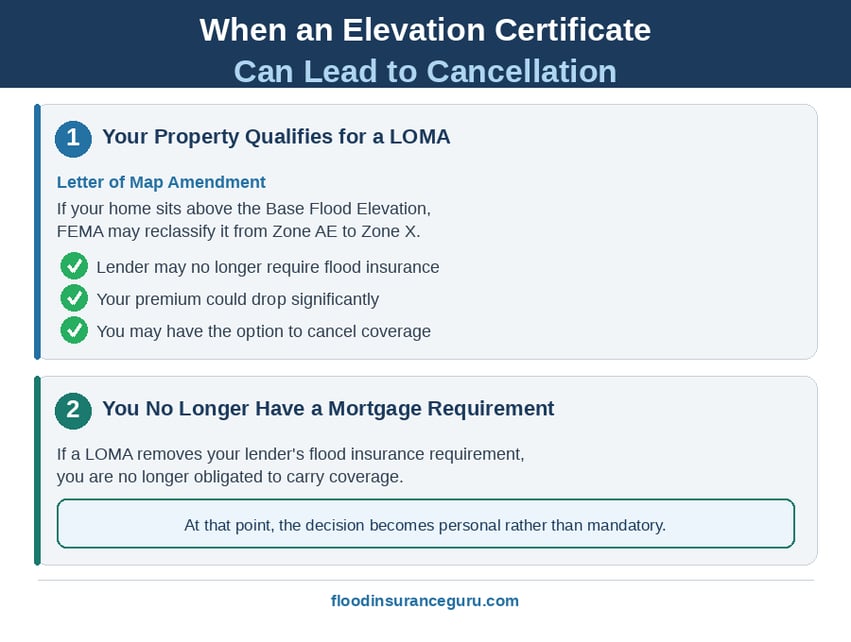
Has your property been reclassified through a LOMA, or is it still in a high risk zone?
This determines whether you are required to carry coverage.
Step 2: Understand Your Actual Premium Options
With updated elevation data, your pricing may be very different.
This is the time to:
- Requote your policy
- Compare NFIP and private flood options
- Evaluate different deductibles
Step 3: Evaluate Your Financial Risk
Ask yourself:
- Could you afford to repair or rebuild after a flood without insurance
- Would a flood loss impact your long term financial stability
- Are you comfortable taking on that risk
Step 4: Make a Decision Based on Risk, Not Just Price
This is where most homeowners get stuck.
They focus only on whether they can cancel, instead of whether it makes sense to cancel.
Flood insurance is not just about meeting requirements. It is about protecting against a low frequency, high severity event.
Frequently Asked Questions
Does an elevation certificate automatically lower my flood insurance?
Not always. It can lower your premium if your elevation is more favorable than previously estimated, but results vary by property.
Can I cancel flood insurance after getting a LOMA?
Yes, if your lender no longer requires coverage, you can choose to cancel. However, you should still evaluate your actual flood risk before making that decision.
What is a LOMA and why does it matter?
A LOMA is a FEMA determination that your property is not in a high risk flood zone. It can remove lender requirements and reduce insurance costs.
Is flood insurance still worth it in a low risk zone?
For many homeowners, yes. Flooding can occur outside high risk zones, and coverage is often more affordable once risk is reassessed.
What This Means for You
Getting an elevation certificate is a smart move. It gives you better data, more control, and more options. But it does not automatically mean you should cancel your flood insurance.
An elevation certificate helps you understand your actual risk and your true pricing, not just what was assumed before. From there, you can make an informed decision.
The right answer depends on your property, your risk tolerance, and your financial situation.
The goal is not just to lower your premium, it’s to make sure you are protected in a way that actually fits your risk. click below to access your free guide to elevation certificates.
