


10-second summary: Most people in Ireland take out life insurance until their youngest child becomes financially independent (usually around age 25) or until their mortgage is cleared. The right policy term depends on your family situation, income, and what you’re trying to protect.
How many years do I actually need life insurance for?
If you’ve decided that now’s the time to get life insurance for your family, congratulations.
It’s a smart move and the grown-up thing to do.
But how do you choose the right number of years for your cover?
By the way, to avoid confusion, the amount of years on your policy = the term of your policy.
The length of cover you choose can significantly impact how much you pay.
The longer the term, the higher the premium.
Why?
The longer the term, the more time Grim Reaper has longer to find you or going all boring actuary “statistically, the chance of a claim increases the longer the policy runs”.
So it’s important to pick a time frame that matches your needs. Otherwise, you could end up paying for cover you no longer need, or worse, having your policy end while your family still depends on your income.
There are a few common quesitons that help figure out the right term, so let’s walk through them.
How long should life insurance last if you have children?
If you think about it, as a parent your job is to provide for your kids and make sure they reach adulthood safely.
While you’re above ground, that’s easy to do with the cold hard cash you earn every month.
But what if Old Reaper calls earlier than planned?
Your pay cheques stop immediately, which means your family loses the income you would have earned in the future.
That future income can add up to a serious amount.
Let’s say you earn €50,000 a year and pass away at 45 with 20 years left until retirement.
That represents roughly €1 million in future income your family could lose.
Life insurance replaces that lost income with a tax-free lump sum so your family can keep the lights on while they process what has just happened.
So what term should you choose?
In Ireland we generally recommend cover until your youngest child reaches around age 25.
For example:
If your youngest child is currently 4 years old, a 21-year policy would normally make sense.
We also recommend including a conversion option.
This allows you to extend or replace your policy later without answering new medical questions.
Once your youngest reaches adulthood and is financially independent, you can let the policy expire or extend it if your circumstances change.
Of course, if you expect your children to rely on you for longer, you can simply choose a longer term from the start.
What term works best if you’re a one-income household?
If your partner depends on your income, the goal is to protect that income for as long as it exists.
In this situation we usually recommend cover until retirement age.
However, because longer policies cost more, some people choose a shorter policy initially and rely on the conversion option later.
For example, a 10-year policy with a conversion option.
Just keep in mind:
The premium will be recalculated when you extend the policy because you will be older at that stage.
Also, while the initial premium is higher, a single 30-year fixed premium policy will usually work out cheaper than converting three separate 10-year policies over time.
I hope that makes sense 🧠
What’s the right length of cover for funeral expenses?
If your goal is simply to cover final expenses, you normally have two options.
a) a whole of life policy
b) a term policy with a whole of life continuation option (the type that can eventually pay for itself)
Whole of life policies are more expensive because the payout is guaranteed.
You can’t outrun Mr Reaper forever so a whole of life policy will eventually pay out.
Some people prefer a cheaper term policy to age 80 or 85 instead, accepting the risk that they might outlive the policy.
If that happens, the insurer keeps the premiums and the policy simply expires.
What if I’m planning for inheritance tax?
Not every life insurance policy is about replacing income.
Sometimes it’s simply about protecting assets.
If you leave assets behind when you die, your beneficiaries may have to pay inheritance tax
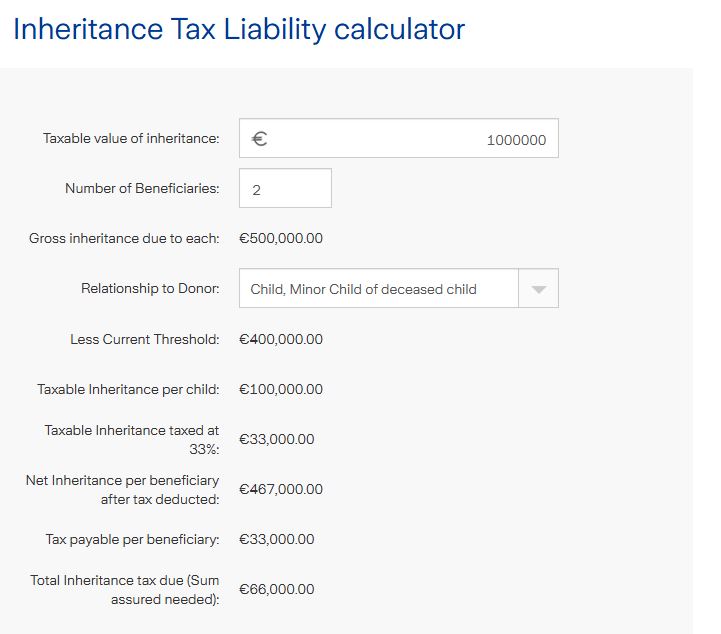
Imagine your estate is worth €1 million and you leave it to two children.
Assuming they haven’t already used their lifetime inheritance thresholds, they could each face a tax bill of around **€66,000**.
Most people don’t have that kind of money sitting around.
This is where a Section 72 life insurance policy comes in handy.
A Section 72 plan pays the inheritance tax bill directly to Revenue so your children receive the full inheritance.
These policies are normally set up as whole of life plans because the tax liability will eventually arise.
I don’t have children but want to leave money behind. What term works best?
Sound the generous aunties and uncles alarm!
The right term depends on who you’re leaving money to and when they might need it.
For example:
If the gift is for a niece or nephew’s education, you might match the term to when they finish college.
If you want to leave something to a charity or cause you care about, a whole of life plan usually makes more sense.
Over to you
If you’re still unsure about the right term for your life insurance, that’s completely normal.
At Lion.ie we arrange policies across all major Irish insurers, so the advice we give about policy length is based on how policies actually work in Ireland.
Different insurers assess risk slightly differently as well, which means if you’re unsure about the right type of policy or length of cover it’s usually better to explore the options first rather than apply blindly.
Choosing the wrong policy length isn’t usually catastrophic, but choosing the wrong structure can be expensive and fixing it later often costs more.
If you’d like a recommendation based on your circumstances, complete this short questionnaire and I’ll come back to you with some ideas.
Or schedule a call back here.
That’s what Denis did.

Editor’s Note: This article was originally published in 2021 and reviewed and updated in 2026 to reflect how life insurance policies are typically structured in Ireland today.

Written by Nick McGowan, QFA RPA APA
Nick is a qualified financial advisor and founder of Lion.ie, a multi-agency Irish life insurance and income protection brokerage based in Tullamore.
He’s been helping people secure fair, transparent cover for over 15 years and was named Protection Broker of the Year 2022.
If you’d like straight answers without the sales pitch, learn more about Nick here.