


10-second summary:
Life insurance payouts are not automatically taxed in Ireland. When tax applies, it’s usually because of how the policy was structured and the relationship between the person who dies and the person receiving the payout. Getting this wrong can create a large, permanent tax bill.
Life insurance payouts are not automatically taxed in Ireland.
When tax applies, it is usually because of how the policy was set up, not because of the policy itself.
The key factor is the relationship between the person who dies and the person receiving the payout.
If you’re married or in a civil partnership
If your spouse or civil partner dies and you receive the life insurance payout, there is no tax to pay.
It does not matter how large the policy is.
For example:
Sue-Ellen has a life insurance policy for €10 million in her own name.
She dies.
Her husband JR receives the full €10 million.
There is no Capital Acquisitions Tax to pay, which is what most people mean when they talk about inheritance tax.
That part is straightforward.
If you’re not married or in a civil partnership
This is where people get caught out.
If you are living together but not married, Revenue treats you as unrelated for tax purposes.
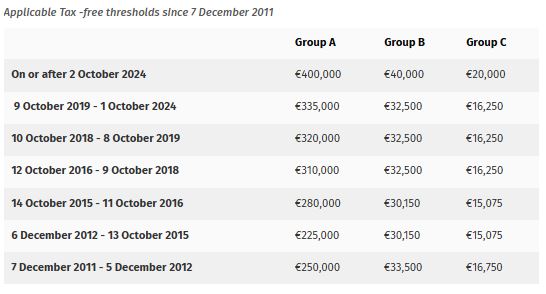
That means a life insurance payout can be subject to 33 percent Capital Acquisitions Tax once it exceeds the Group C lifetime threshold.
Using the same example:
Sue-Ellen dies with a €10 million life insurance policy.
JR was her long-term partner, but they were not married.
JR can receive €20,000 tax-free.
Everything above that is taxed at 33 percent.
That creates a tax bill of just over €3.29 million.
This is one of the most expensive mistakes people make with life insurance, and most only discover it after someone has already died.
How Much Tax Applies to Life Insurance?
Life insurance payouts themselves are not automatically taxed.
When tax applies, it is charged under Capital Acquisitions Tax at a rate of 33 percent, after the relevant lifetime threshold.
In plain English:
- Children can inherit up to €400,000 tax-free from parents over their lifetime. Anything above that is taxed at 33 percent.
- Siblings, nieces and nephews can inherit up to €40,000 tax-free.
- Unmarried partners and most other people can inherit just €20,000 tax-free.
Once the threshold is used up, the balance is taxed at 33 percent.
This is why who owns the policy and who pays the premium matters far more than most people realise.
If you want a second pair of eyes on how to structure your cover, the next step is to complete this short questionnaire and I’ll take a look.
Can Unmarried Couples Avoid Life Insurance Tax?
Yes, but only if the policy is structured correctly from the start.
The most common solution is a life of another arrangement, where each partner owns the policy on the other life and pays the premiums themselves.
Done properly, the surviving partner receives the payout as the legal owner of the policy, not as an inheritance.
Get this wrong and the tax bill can be enormous.
Get it right and the payout is usually tax-free.
This is exactly why applying incorrectly can cause long-term damage that cannot be undone later.
What Happens If You Get Married Later?
If you get married or enter a civil partnership, the tax treatment changes.
Life insurance payouts between spouses or civil partners are not subject to Capital Acquisitions Tax, regardless of policy size.
That means the inheritance tax issue described above no longer applies once you are married.
However, this does not automatically mean you should cancel or restructure existing policies.
If you already have single “life of another” policies in place, they may still make sense to keep, particularly if:
- your health has changed since the policy started
- you are older and new cover would be more expensive
- you want flexibility rather than a joint policy
The key point is this: marriage changes the tax position, but it does not mean existing cover should be altered without checking the consequences first.
Is Life Insurance Tax Deductible?
In most cases, no.
Premiums on standard term life insurance are not tax-deductible.
There are two main exceptions:
- Pension Term Assurance, where premiums can qualify for income tax relief
- Company-paid life insurance for directors, where premiums may be deductible for the business in certain circumstances
What If the Payout Is Invested?
If you invest the proceeds of a life insurance payout, any growth on that investment is taxable.
In Ireland, investment growth is generally taxed at 41 percent exit tax.
The life insurance payout itself may be tax-free, but what you do with it afterwards still matters.
What About Monthly Income Life Insurance?
Monthly income life insurance payouts are paid tax-free to the beneficiary.
As with lump sums, any growth on invested amounts is taxable.
Is Mortgage Protection Taxable?
Mortgage protection usually pays directly to the lender to clear the loan.
Between married couples or civil partners, there is no tax issue.
For cohabiting couples, structure matters, particularly where property ownership and inheritance tax come into play.
If you are buying together and not married, there are specific pitfalls to avoid:
Mortgage protection for cohabiting couples
Over to You
This page is a general guide to how life insurance and tax interact in Ireland.
If your situation involves large policies, unmarried partners, property, or business ownership, the details matter and mistakes tend to be permanent.
I’m not a tax advisor, and this isn’t tax advice. It’s practical guidance based on how insurers and Revenue rules interact in the real world.
Thanks for reading
Nick
Editor’s note: First published in 2020. Rebuilt in 2026 to reflect current Irish tax thresholds, underwriting practice, and how life insurance payouts are actually assessed in real cases.

Written by Nick McGowan, QFA RPA APA
Nick is a qualified financial advisor and founder of Lion.ie, an independent Irish life insurance and income protection brokerage based in Tullamore.
He’s been helping people get fair, transparent cover for over 15 years and was named Protection Broker of the Year 2022.
If you’d like straight answers without the sales pitch, learn more about Nick here.