

The Social Security Administration (SSA) releases workload data every year showing how many disability claims were decided at each stage of the process — and how many were approved or denied. The FY 2025 figures reveal a stark reality: most applicants are turned down initially, but the process does not end there. Understanding where approvals actually happen can mean the difference between giving up on a valid claim and winning the benefits you deserve.
What is a “Waterfall Chart?
The term “waterfall chart” in the context of an SSDI claim comes from the visual appearance and structure of how decisions are made.
- The decision process is sequential and step-down in nature.
- Each step flows into the next, just like water cascading downward.
- Once a claim fails at a particular step, the process stops there, and the claim is denied—like water dropping off a ledge and not returning upstream.
Please see the attached chart for this visual representation.
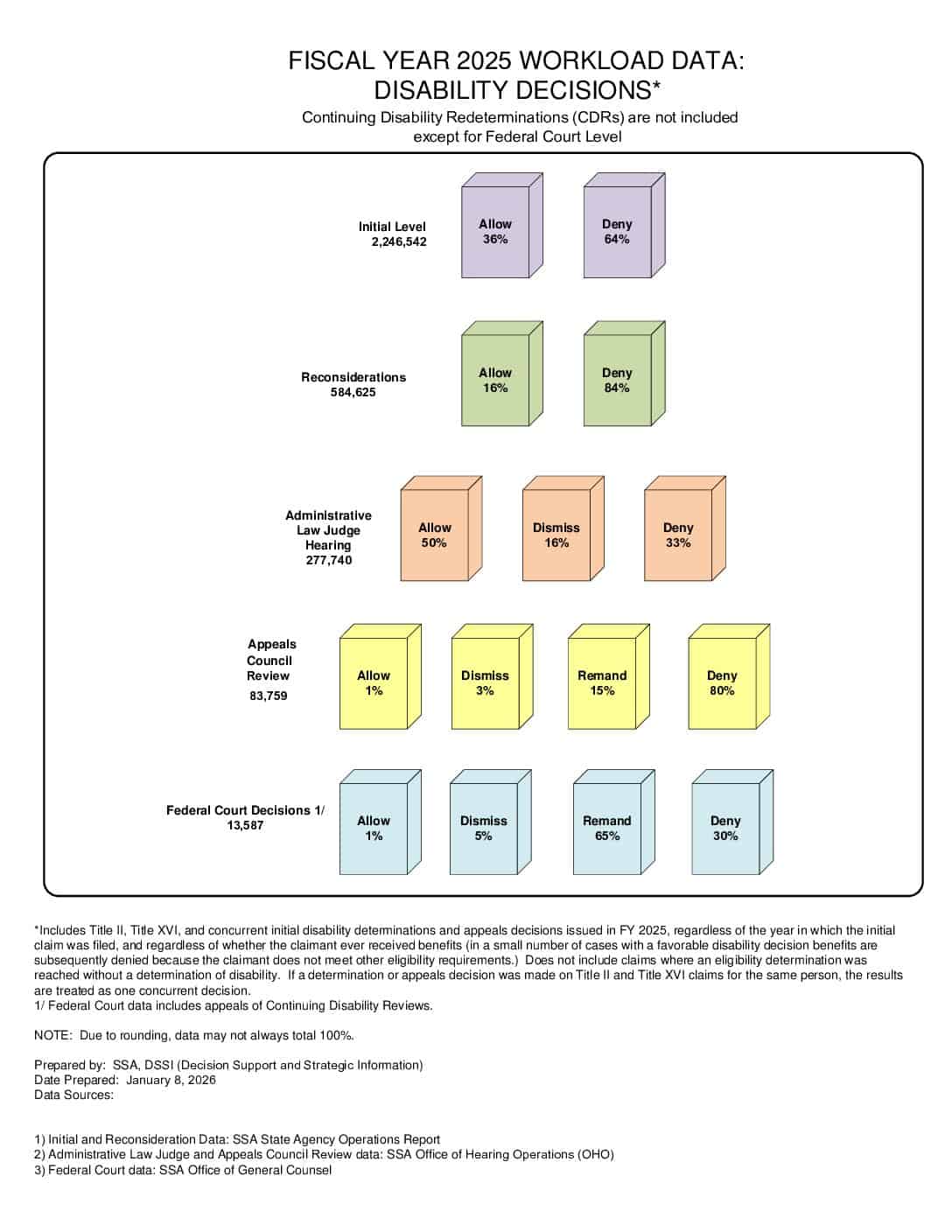
What Does the SSA’s Disability Decision Waterfall Chart Show?
The SSA’s FY 2025 workload data tracks every disability decision from the initial application through federal court, creating a picture of how claims move through the system. The data covers Title II (SSDI), Title XVI (SSI), and concurrent claims decided in fiscal year 2025, regardless of when the original claim was filed.
In total, over 3.2 million disability decisions were issued across all levels in FY 2025. The vast majority — more than 2.2 million — occurred at the initial application stage, with the numbers shrinking at each successive level as claimants either stop pursuing their case or receive a decision.
| Appeal Level | Total Decisions | Approval Rate |
| Initial Application | 2,246,542 | 36% |
| Reconsideration | 584,625 | 16% |
| ALJ Hearing | 277,740 | 50% |
| Appeals Council | 83,759 | 1% |
| Federal Court | 13,587 | 1% |
Note: Approval rates are derived from SSA’s FY 2025 workload report. Reconsideration and Appeals Council figures reflect approximate allowance rates based on reported data. Federal court remands (65%) frequently result in subsequent approvals at lower levels.
Why Are 64% of Initial Disability Applications Denied?
At the initial application level, SSA denied 64% of the 2,246,542 claims decided in FY 2025 — and only 36% were approved outright. The high denial rate at this stage is not necessarily a sign that claimants lack legitimate disabilities. Initial applications are reviewed by state agency examiners who often make decisions based on incomplete medical records and without the benefit of a hearing where a claimant can explain how their condition actually affects their daily life.
Common reasons for initial denials include insufficient medical documentation, earnings above the substantial gainful activity (SGA) threshold, conditions that do not yet meet SSA’s 12-month duration requirement, or technical eligibility issues. Many of these problems are correctable at the appeal stages — which is why the approval rate climbs dramatically as claimants advance through the system.
Does Reconsideration Give You a Real Second Chance?
Reconsideration is the first step in the disability appeal process, but the FY 2025 data shows it is the hardest early level to win. Approximately 84% of reconsideration decisions resulted in denials. The reconsideration process involves a different state agency examiner reviewing the same file, and without new and substantial medical evidence, outcomes rarely change.
Despite the low approval rate, reconsideration is a required step in most states before a claimant can request an ALJ hearing. Filing your reconsideration promptly — within 60 days of a denial — preserves your right to reach the ALJ stage, where your odds improve substantially. If you skip reconsideration, you generally lose your appeal rights and must start over with a new application.
At What Stage Do Most Disability Claimants Actually Win?
The ALJ hearing is where the numbers shift decisively in claimants’ favor. In FY 2025, 50% of the 277,740 ALJ hearing decisions resulted in approvals. This is the level at which claimants can appear in person (or by video) before an administrative law judge, present testimony, offer new medical evidence, and have the support of a representative who understands how to frame a case under SSA’s listing criteria.
The ALJ hearing stage is the most important opportunity most denied claimants will ever have. A judge who hears directly from you and your medical experts has far more context than a file reviewer who never sees the person behind the application. This is also where experienced legal representation makes the greatest measurable difference in outcomes.
Your Claim Was Denied. You Still Have Options.
The SSA’s own data shows that most people who appeal eventually win. The Ortiz Law Firm helps disability claimants fight back. Call (888) 321-8131 for a free consultation.
What Happens If You Lose at the ALJ Hearing?
How Does the Appeals Council Review Work?
If an ALJ denies your claim, you can request review by SSA’s Appeals Council. In FY 2025, the Appeals Council reviewed 83,759 cases. The Council does not hold hearings — it reviews ALJ decisions for legal or procedural errors. The majority of Appeals Council decisions result in a denial of review (meaning the ALJ’s decision stands) or an outright denial on the merits.
However, the Appeals Council can also remand a case back to an ALJ for a new hearing, which gives claimants another shot at approval. Think of a remand as a “do over” hearing before an Administrative Law Judge. In FY 2025, remands accounted for 15% of Appeals Council outcomes. If the Council identifies a flaw in how your ALJ hearing was conducted — such as failure to properly weigh medical opinion evidence — you may get a second ALJ hearing with a corrected process.
RELATED POST: Overcoming a Prior ALJ Denial In Social Security Disability Claims
Is Federal Court Worth Pursuing After an Appeals Council Denial?
Federal court is the final avenue of appeal, and the FY 2025 data shows it is rarely the stage where claims are outright approved — only 1% of the 13,587 federal court decisions resulted in an allowance. But the remand rate tells a more optimistic story: 65% of federal court decisions are remands, sending the cases back to SSA for further proceedings, which often leads to approval at the ALJ level.
Federal court requires filing a civil action in U.S. District Court within 60 days of an Appeals Council decision. The judge reviews whether SSA’s decision was supported by substantial evidence and whether proper legal standards were applied. Because federal litigation is complex and expensive, it is typically pursued only in cases with strong legal arguments — and having a disability attorney who handles federal court cases is essential.
What Do These Numbers Mean for Your Disability Claim?
The FY 2025 data reinforces a consistent pattern: the further into the appeals process a claimant goes, the more likely they are to have been represented by an attorney or advocate. Claimants who hire a disability attorney are statistically more likely to reach the ALJ hearing stage, more likely to have complete and properly organized medical evidence, and more likely to win.
If your claim was denied at any level, the data shows you should not give up. The system is designed to be difficult at the initial stages, but it provides multiple opportunities to correct mistakes and present your case more fully. The key is acting within the appeal deadlines — typically 60 days from the date of your denial notice — and getting professional help as early in the process as possible.
- File every appeal within 60 days of a denial notice
- Gather new and updated medical records before your next appeal
- Consult with a disability attorney before your ALJ hearing
- Do not restart with a new application if you still have time to appeal
Frequently Asked Questions
What percentage of Social Security disability claims are approved at the initial level in FY 2025?
Only 36% of the 2,246,542 initial disability applications decided in FY 2025 were approved. The SSA denied 64% at this stage. These numbers highlight why pursuing all available appeals is so important for claimants with legitimate disabilities.
At which appeal level do disability claimants have the best chance of winning?
The ALJ hearing level has the highest approval rate in the SSA system. In FY 2025, 50% of ALJ hearing decisions resulted in approvals — far higher than the 36% initial approval rate or the 16% approval rate at reconsideration. Reaching the ALJ stage with strong medical evidence and legal representation significantly improves your odds.
What does a federal court remand mean for a disability claimant?
A remand means the federal court has sent the case back to SSA — usually to an ALJ — for a new hearing or additional consideration. In FY 2025, 65% of federal court disability decisions were remands. Many remanded cases are ultimately approved at the ALJ level, making the remand a meaningful step toward eventual approval.
Data Source: SSA, DSSI (Decision Support and Strategic Information), FY 2025 Workload Data: Disability Decisions, prepared January 8, 2026.