

Many applicants for Social Security Disability believe that earning a single paycheck will instantly destroy their chances of approval. Contrary to this popular fear, the administration actually offers a safety net known officially as an Unsuccessful Work Attempt (UWA). This rule acknowledges that trying to return to the workforce is often a test of your health rather than a guarantee that you have fully recovered.
Under normal circumstances, the government uses Substantial Gainful Activity (SGA) earnings limits as a financial barometer to decide if you are “disabled.” If your income crosses this specific dollar threshold, officials typically assume you are healthy enough to support yourself.
However, the failed work attempt rule acts as a crucial exception, protecting your benefits if you tried to work but had to stop within six months because of your medical condition.
Instead of viewing a short-lived job as a mistake, this regulation allows you to use that experience as evidence that your limitations are genuine. Correctly leveraging unsuccessful work attempts in disability claims transforms what feels like a risky gamble into evidence that can support your claim.
The 6-Month Threshold: How SSA Measures Your Effort to Work
Social Security looks at the calendar to decide if your return to work was a success or a struggle. Generally, any job that lasts longer than six months is viewed as proof that you can hold down steady employment, even if it was difficult. However, if your employment ends before that 180-day mark, the SSA is much more likely to view it as a “failed work attempt” that shouldn’t hurt your claim.
Think of the SSA six month rule for working as a test of endurance rather than skill. The government wants to see if your return to the workforce is sustainable. If you push past the half-year mark, the assumption shifts; they believe you have successfully adapted to your condition. Conversely, stopping early is often seen as evidence that your disability is still the primary barrier to earning a living.
Duration is only half the battle, though. Even if you quit after two weeks, you won’t get credit for a failed attempt if you leave for the wrong reasons, such as a layoff or a personality clash. How returning to work affects SSDI eligibility depends heavily on proving exactly why the job ended.
Why Your Job Ended Matters: Medical vs. Non-Medical Reasons
Simply quitting a job within six months doesn’t automatically protect your benefits; the specific cause of your departure is what the Social Security Administration (SSA) scrutinizes most. To qualify as an unsuccessful work attempt, you must prove the medical reasons for stopping employment—or the removal of special help—were the direct cause.
If you were laid off due to downsizing, fired for a personality clash, or left because of transportation issues, the SSA usually views your earnings as proof that you have the capacity to work. For the safety net rule to apply, the evidence must demonstrate that your health was the ultimate barrier, proving that your body or mind simply could not sustain the activity.
Fluctuating symptoms can complicate this picture, especially for conditions that come and go. The SSA acknowledges that you may experience temporary medical improvement during work efforts, only to have your condition regress once the physical or mental stress of daily employment sets in.
If you start a job feeling strong but are forced to resign when your symptoms flare up again, this relapse actually validates your claim rather than hurting it. It serves as real-world evidence that while you might have sporadic good days, they are not consistent enough to maintain Substantial Gainful Activity over the long term.
Many applicants naturally panic, asking “will a short-term job ruin my disability case if I didn’t explicitly tell my boss about my health?” The answer often depends on how clearly you can link your performance issues to your condition in your report to the SSA.
Even if you didn’t list a disability on your formal resignation letter, you can still provide evidence that you physically couldn’t keep up with the required duties. This distinction becomes even more critical if you only managed to last a few months because your employer was giving you extra help or lowered expectations that regular employees don’t receive.
Did You Have Help? Using ‘Special Conditions’ to Support Your Claim
Just because you received a full paycheck doesn’t necessarily mean the Social Security Administration believes you truly “earned” it. In disability claims, the SSA looks at the actual value of your work, not just the dollar amount printed on your pay stub.
If your employer paid you the same hourly rate as healthy workers but you required extra supervision, worked slower, or had fewer duties because of your health, the SSA considers part of your wage a “subsidy.” They may deduct that subsidized portion from your total monthly earnings, potentially dropping your countable income below the strict SGA limit and keeping your claim alive.
These situations are officially known as special conditions at work for disabled employees, and they serve as strong evidence that you cannot function in a competitive environment without assistance. If your job environment was “sheltered” or highly accommodated, it proves that your employment wasn’t a true reflection of your capacity to work.
Common examples of these conditions include:
- Receiving assistance from other employees to finish your assigned tasks.
- Being allowed frequent rest periods or irregular hours due to symptoms.
- Working for a relative who tolerates lower productivity than they would from a stranger.
- Using specialized equipment or simplified duties not provided to other staff.
To use this rule effectively, you generally need an employer statement for unsuccessful work attempts (often collected via Form SSA-3033). This critical document allows your former boss to confirm that you were paid more than your productivity warranted.
Proving inability to sustain full time employment often comes down to this specific paperwork, showing that without special treatment, you would not have been hired or kept on. This helps distinguish a failed attempt from a successful return to work, a distinction that gets even trickier when confusing these rules with benefits for those already on the rolls.
Trial Work Period vs. Unsuccessful Work Attempts: Know the Difference
Getting tangled in government vocabulary is easy, especially when researching rules about returning to a job. A common mistake is confusing an “Unsuccessful Work Attempt” (UWA) with the “Trial Work Period” (TWP). While both rules involve working, they apply to completely different stages of your Social Security Disability journey.
The TWP is a perk strictly for people already receiving checks who want to test their ability to work without losing income. If you are still applying or waiting for a decision, the TWP does not apply to you yet; instead, you rely on the UWA rule to protect your back pay.
Unlike the Trial Work Period, which is a one-time bucket of nine months that you “spend” regardless of success, an Unsuccessful Work Attempt is not a limited resource you have to save. It is simply a safety net allowing the SSA to disregard earnings from a job that ended quickly because of your medical condition. Reporting unsuccessful work trials to Social Security correctly ensures they classify the income as a failed attempt rather than a successful return to the workforce.
Knowing where you stand prevents you from quoting the wrong rule to a caseworker. The breakdown of failed work attempt vs trial work period is as follows:
- Who It Is For: Unsuccessful Work Attempt is primarily for applicants; Trial Work Period is for current beneficiaries.
- Time Limit: Unsuccessful Work Attempt covers jobs lasting up to 6 months; Trial Work Period covers 9 months of service.
- The Result: Unsuccessful Work Attempt erases the earnings from your record; Trial Work Period allows you to keep earnings on top of benefits.
Once you confirm which rule protects you, the next challenge is documenting exactly why the job ended.
Step-by-Step: Gathering the Proof Your Disability Stopped Your Work
Proving that your job ended because of your health, rather than a layoff or personal choice, requires proactive steps. The most critical tool in your arsenal is Form SSA-821-BK (Work Activity Report).
This isn’t just paperwork; it is your chance to tell the story of your attempt to return to work. When filling it out, be specific about any special help you received—like extra breaks, lower production goals, or fewer hours—and clearly state that your medical condition was the primary reason you could not continue.
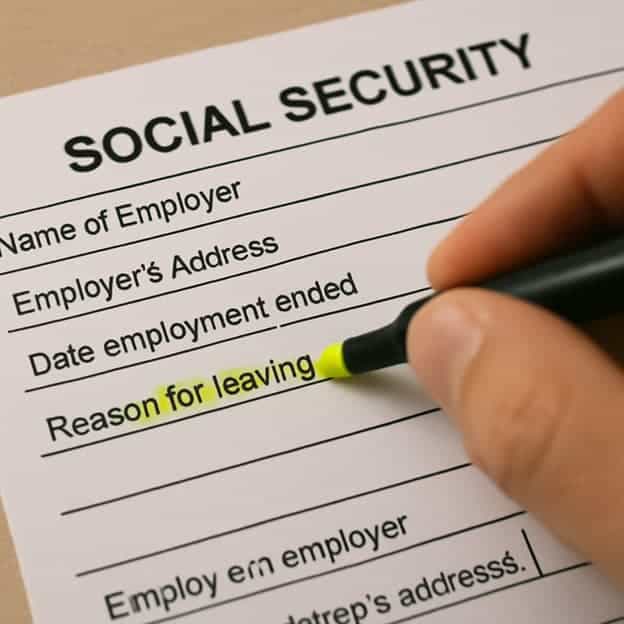
Your own words carry weight, but independent verification often seals the deal. A simple employer statement for unsuccessful work attempts can be the difference between a denial and an approval. Ask your former manager to write a brief note confirming that you struggled to perform duties, required special accommodation, or had excessive absences before leaving. Simultaneously, visit your doctor immediately after stopping work. This creates a medical “timestamp” proving that your symptoms flared up exactly when the job ended, linking your health directly to the failed attempt.
Gaps in evidence often lead to confusion regarding the impact of part time work on pending disability application. Even if you only worked minimal hours, you must document that the effort was unsustainable to ensure those earnings don’t count against you.
Keep a dedicated file with these essentials to protect your claim:
- Form SSA-821-BK: Completed with detailed examples of work modifications.
- Termination or Resignation Letter: Explicitly citing health reasons if possible.
- Medical Progress Notes: Dates correlating with your work stoppage.
- Pay Stubs: Showing the start and end dates clearly.
Your Action Plan for Returning to Work Safely
Understanding the rules around unsuccessful work attempts in disability claims transforms a potential risk into a strategic advantage. You no longer have to view a return to employment as an “all or nothing” gamble that jeopardizes your financial security.
Instead, you can see a job trial for what it truly is: a test. If you sustain employment, you gain independence; if you cannot, the attempt becomes powerful proof that helps to confirms your limitations under the Social Security Blue Book criteria for inability to work.
To ensure your attempt is documented correctly, follow this strategy:
- Consult Your Doctor: Discuss medical risks and potential vocational rehabilitation services for disabled workers before starting.
- Keep a Journal: Record daily symptoms, special accommodations you needed, and specific duties you struggled to finish.
- Report Promptly to SSA: Notify Social Security immediately when you start work and exactly when—and why—you stop.
You now possess the tools to navigate this complex system with peace of mind. Whether you successfully return to the workforce or prove that you need continued support, you are now in control of the evidence.
Frequently Asked Questions
Will taking a short-term job ruin my disability claim?
No. A brief job can be treated as an Unsuccessful Work Attempt (UWA) if it ends within six months due to your medical condition or the loss of special help at work. Earnings from a UWA are generally not counted against you under the Substantial Gainful Activity (SGA) rules. The key is why the job ended. Medical reasons (including a relapse after temporary improvement) support a UWA, while non-medical reasons like layoffs, transportation issues, or personality conflicts usually do not.
How does the six-month rule work?
Short answer: Duration and cause both matter. If your work stops:
- 6 Months or Less: To consider work activity a possible UWA:
- Work activity must have ended, or have been reduced to the non-SGA level, due to the impairment; or
- Work activity must have ended or have been reduced because of the removal of special conditions related to the impairment that are essential to the further performance of work.
- Over 6 Months: SGA-level work lasting more than 6 months cannot be a UWA regardless of why it ended or reduced to the non-SGA level.
Question: What counts as “medical reasons,” and how do I prove them?
Medical reasons include symptom flares, functional limitations, or regression after a temporary improvement that made continuing work impossible. Proof comes from aligning your story and third-party evidence: complete Form SSA-821-BK with specifics on what you couldn’t do, get a contemporaneous doctor visit and progress notes tying symptom worsening to your work stoppage, and request an employer statement describing accommodations, performance struggles, or excessive absences. Non-medical causes (downsizing, conflicts, commute problems) generally won’t qualify.
What are “special conditions” at work, and how can they help my claim?
Special conditions are extra help or accommodations showing your pay exceeded the actual value of your work (a “subsidy”). Examples include extra supervision, slower productivity expectations, frequent rest breaks, irregular hours, simplified duties, or working for a relative who tolerates reduced output. SSA can deduct the subsidized portion from your earnings, potentially dropping you below SGA. To document this, ask your employer to complete an employer statement (often via Form SSA-3033) confirming the accommodations and reduced productivity.
What’s the difference between an Unsuccessful Work Attempt and a Trial Work Period?
They apply at different stages and have different effects. A Unsuccessful Work Attempt (UWA) is for applicants (not yet receiving checks) and covers jobs up to 6 months that end for medical reasons; SSA can disregard those earnings. A Trial Work Period (TWP) is for current beneficiaries and provides nine months to test working while keeping benefits; earnings still count, but you don’t lose checks during those months. The UWA isn’t a limited “bucket” you spend—it’s a safety net for short, medically ended jobs—whereas the TWP is a defined set of months you use once you’re on benefits.